
Water or fire damage in Seattle? Call 206-621-7774 at any hour. For water, we stop the source, extract the standing water, dry the structure and write the mitigation scope for your insurer. The EPA says water-damaged areas and items should be dried within 24 to 48 hours to prevent mold growth. After a fire, we board up openings, remove the water left by firefighting, clean smoke and soot, and pack out and store your belongings.
Water and Fire Damage Restoration in Seattle
We work in every Seattle neighborhood, from Ballard and Queen Anne to West Seattle and Rainier Valley.
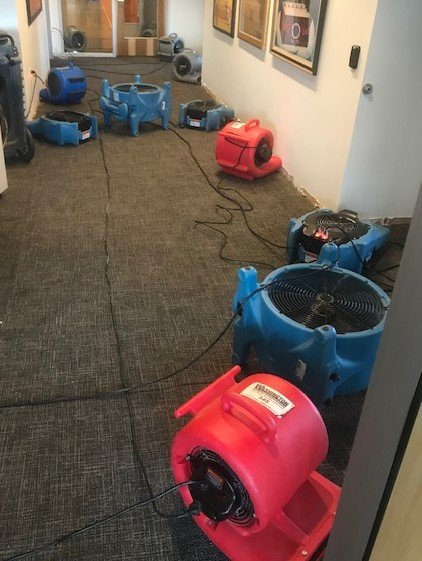
Water extraction and drying
We stop the source, extract the standing water and dry the structure, not just the surfaces. More on water damage restoration.
Fire damage and board-up
Broken windows, doors and other openings are boarded up so rain and break-ins do not add to the loss. More on fire damage restoration.
Smoke and soot cleaning
Walls, ceilings, floors and contents are cleaned of soot, including rooms the fire never reached. See smoke damage restoration in Seattle.
Sewage cleanup
A sewer backup is its own job, and not one to clean up yourself. See our sewage cleanup page.
Mold
Drying within 24 to 48 hours is what prevents mold growth. Where it has already started, see mold remediation in Seattle.
The scope for your insurer
The damage is written up room by room for your insurer. Our insurance page explains how we work with carriers.
Water, Sewer and Drainage Across Seattle
Seattle Public Utilities manages the public water, sewer and drainage systems for the whole city, so these basics are the same in every neighborhood.
Seattle Public Utilities
Seattle Public Utilities (SPU) supplies the city’s drinking water. Its 2025 water quality report says 62% came from the Cedar River and 38% from the South Fork Tolt River.
SPU’s 24-hour Operations Response Center, at 206-386-1800, takes urgent reports such as water outages, discolored water or hydrant leaks.
Your shutoff, and SPU’s
SPU says a home’s main shut-off valve can be indoors or outdoors, usually in a basement, crawl space or garage, and should be closed immediately if a pipe bursts. If the valve cannot be closed, customers can call 206-386-1800, staffed 24/7, and a crew member will turn the water off at the meter for a service charge.
Under SPU’s water service rule, SPU’s service ends at the water service union after the meter. The pipe from there onto your property is the customer-owned private water line.
Side sewers belong to the owner
SDCI Tip 503 states that side sewers, whether on public or private property, are owned, installed, operated and maintained by the owner, operator or occupant of the parcel served. A side sewer permit is required before work begins; emergency repairs may start first if the application is filed no later than the next business day.
Only a Registered Side Sewer Contractor may work in the right-of-way. Questions go to the SDCI Drainage & Sewer Review Desk at 206-684-5362.
Sewer backups
For a sewer backup, SPU’s troubleshooting handout lists calling Seattle Public Utilities at 206-386-1800 as one of the steps. It also says to call Puget Sound Energy at 1-888-225-5773 before trying to clear a blocked side sewer, to avoid damaging a gas line.
The City’s 2015 Comprehensive Plan Draft EIS says combined, fully separated and partially separated sewer systems each serve about one-third of the city. Combined sewers carry both sewage and stormwater runoff.
Flooding, Drainage and Slopes by Seattle Neighborhood
What the City of Seattle and King County have published about each part of the city.
West Seattle
Longfellow Creek is one of the creeks covered by Seattle’s Floodplain Development Code. The City’s flood hazard analysis notes that the Longfellow Creek detention basin was only partially effective during the January 1986 flood, and that Beach Drive SW runs along Puget Sound and is exposed to coastal flooding.
Its landslide analysis records more than 100 documented landslides along Alki Avenue, one of the two highest counts in the city.
Ballard
Seattle Public Utilities and King County are building the Ship Canal Water Quality Project, a 2.7-mile storage tunnel from Ballard to Wallingford designed to hold more than 30 million gallons of sewage and stormwater during heavy rain. SPU’s Ballard fact sheet says the tunnel was completed in 2023, and that the project’s purpose is to cut the polluted stormwater and sewage that flows into the Ship Canal, Salmon Bay and Lake Union during storms.
The City’s 2023 Climate Vulnerability Assessment maps parts of Sunset Hill among the areas where constrained drainage raises the chance of flooding after heavy rain.
Rainier Valley and Rainier Beach
King County built the Rainier Valley Wet Weather Storage project to keep sewage and stormwater out of the Duwamish River during storms. It added a new sewer pipe near Rainier Avenue South and South Bayview Street and a 340,000-gallon storage tank at South Hanford Street and South 27th Avenue, and was finished in 2018.
In Rainier Beach, the County’s Henderson/M.L. King project, built from 2002 to 2005, included upgrades to the Rainier Beach sewer system, much of which the County described as more than 50 years old. The City’s climate assessment maps parts of Rainier Beach as a constrained drainage area.
Queen Anne
The Seattle Landslide Study names Southwest Queen Anne as one of the five areas of the city with the highest density of landslides, and says water is involved in nearly all cases.
Seattle’s landslide analysis says about 4% of reported landslides have been associated with water leaks, with the leak sometimes causing the slide.
Capitol Hill
The Seattle Landslide Study covers Interlaken in its Capitol Hill section and names it as one of the five areas with the highest density of landslides in the city. It also lists North Capitol Hill among the areas where slides have been recorded.
Human influence was reported in 84 percent of landslides citywide.
Madison Valley
Seattle’s flood hazard analysis says low-lying, bowl-shaped areas like Madison Valley are the most likely to flood. In the storm of December 14 to 15, 2006, about 2.17 inches of rain fell in 24 hours, roughly 300 flooded homes were reported citywide, and a fatality occurred in Madison Valley.
SPU’s capital program lists the Madison Valley Long Term Solution, a stormwater flood control project of about $35.0 million that ran from 2007 to 2015, with a large storm pipe, a storage facility in Washington Park and an enlarged retention area near 30th Ave E and E John St.
Downtown Seattle
The Puget Sound coastline is part of the floodplain covered by Seattle’s Floodplain Development Code. For Downtown and Lower Queen Anne, the City’s 2023 Climate Vulnerability Assessment projects sea level rise of 1.1 feet by 2050 and 3.1 feet by 2100, at a 17% likelihood of exceedance.
It states that relative sea level in Seattle already rose about 8.2 inches between 1899 and 2022.
South Park and Georgetown
SPU reported that on the mornings of December 27 and 28, 2022, the tidally influenced Duwamish River overtopped its banks in South Park, with high tide inundation as the primary cause. It worked directly with more than 15 homes and businesses to assess damage.
SPU says South Park has had stormwater flooding and sewer backups during heavy rain, made worse by high tides. In a November 2024 update it said the South Park Pump Station was completed in 2023 and that sandbags are available to residents and businesses. The City’s climate assessment maps parts of South Park and Georgetown as constrained drainage areas.
Magnolia
Seattle’s landslide analysis records more than 100 documented landslides along Perkins Lane North, and its event history lists a large slump along Perkins Lane that destroyed five homes in the winter of 1995/96.
The Seattle Landslide Study names Southwest Magnolia among the five areas with the highest density of landslides.
North Seattle and Lake City
The City’s flood hazard analysis notes that Lake City Way and 35th Ave NE are bisected by Thornton Creek, and that limited urban flooding hit the residential area near the creek in the winter storms of 1996/1997 and again in October 2003. Thornton and Pipers creeks are both covered by the Floodplain Development Code.
The 2015 Comprehensive Plan Draft EIS says the area north of 85th Street, annexed in 1954, is served mainly by ditch-and-culvert drainage. The climate assessment maps parts of Meadowbrook as a constrained drainage area.
For flood cleanup anywhere in the city, see our Seattle flood damage page. Seattle’s landslide analysis also states that most insurance policies do not cover landslide damage.
What to Do Before We Arrive
After a fire, do not go back in until the fire department says it is safe. For water, start here.
Turn the water off
SPU says a home’s main shut-off valve is usually in a basement, crawl space or garage and should be closed immediately if a pipe bursts. If you cannot close it, call SPU at 206-386-1800 and a crew member will turn the water off at the meter for a service charge.
Stay clear of electricity
Keep out of any room where water is near outlets or electrical equipment.
Leave sewage alone
If the water is from a sewer backup, do not try to clean it yourself.
Photograph it and call your insurer
Photograph the damage before anything is moved, then call your insurer.
Move what you safely can
Move furniture and belongings out of the wet area if it is safe to do so.
Your Insurer Has a Deadline Too
Since 18 October 2026, when your policy requires you to protect the property after a loss, a Washington insurer has five business days to approve the mitigation scope it receives or to send you an approved one (WAC 284-30-330). The rule covers any loss, fire included. We explain how to use it in Washington’s new claim rules.
Seattle Water and Fire Damage Questions
Does Seattle Public Utilities clean up after a sewer backup?
No. SPU’s sewage cleanup brochure says SPU crews do not enter residences to clean up sewage backups, and gives 206-386-1800 as the number for mainline problems. It advises sanitizing and repairing, or removing and discarding, paneling, wallboard or wall coverings within 24 hours. SPU’s troubleshooting handout adds that if a backup was caused by a City issue, the owner can file a claim with the City for reimbursement of costs.
Who is responsible for the side sewer at a Seattle home?
The owner. SPU’s handout tells property owners that they own the side sewer up to the public sewer pipe under the street, and that all repairs in the city right-of-way must be done by a contractor licensed and bonded to work in Seattle.
Does homeowners insurance cover water damage in Seattle?
It depends on where the water came from. Washington’s Insurance Commissioner says a homeowner policy will not cover flooding, which needs separate flood insurance, and that sewer backup and sump overflow cover is an optional endorsement you have to add. Check your declarations page before you need it.
Is my Seattle home in a flood zone?
Seattle’s Floodplain Development Code applies to the designated floodplain along Thornton, Pipers and Longfellow creeks, the Duwamish Waterway and the Puget Sound coastline. SDCI directs residents to FEMA’s Flood Map Service Center, where the map for a property can be found by entering the address, and lists 206-684-8600 for floodplain questions. It also notes that FEMA’s flood maps do not account for the rising flood risk from sea level rise or stronger storms. Flood insurance usually has a 30-day waiting period (FEMA), so it is worth checking before the wet season, not during it.
Rated 4.7 out of 5 on Google (45 reviews). Read our Google reviews.
Water or Fire Damage in Seattle? Call Any Hour
We answer 24 hours a day, every day of the year.
Call 206-621-7774Request an Estimate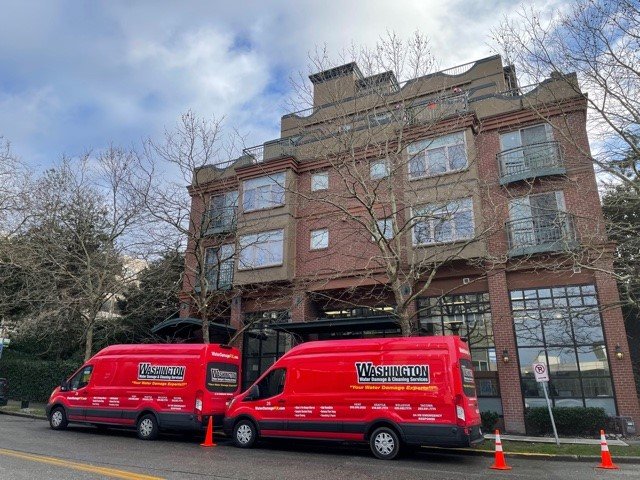
Seattle Neighborhoods & Surrounding Areas We Serve
We work across Seattle, from Ballard, Greenwood and Northgate to West Seattle, Beacon Hill and Rainier Valley, and in the neighboring cities listed below.